

Landowners
The Ahuriri Catchment
The Ahuriri tributaries catchment is a unique and diverse landscape, covering approximately 9,000 hectares. It includes around 1,100 small block landowners (less than 20 hectares), commercial farming and horticulture.
A Catchment Under Pressure
Less than 10% of the catchment remains in native vegetation, with much of the remaining habitat considered acutely threatened. This loss has reduced biodiversity and impacted habitats for native flora and fauna.
Water quality has also been affected, as the removal of vegetation from hillsides and waterways
has increased erosion, sediment, and nutrient runoff into streams and rivers.
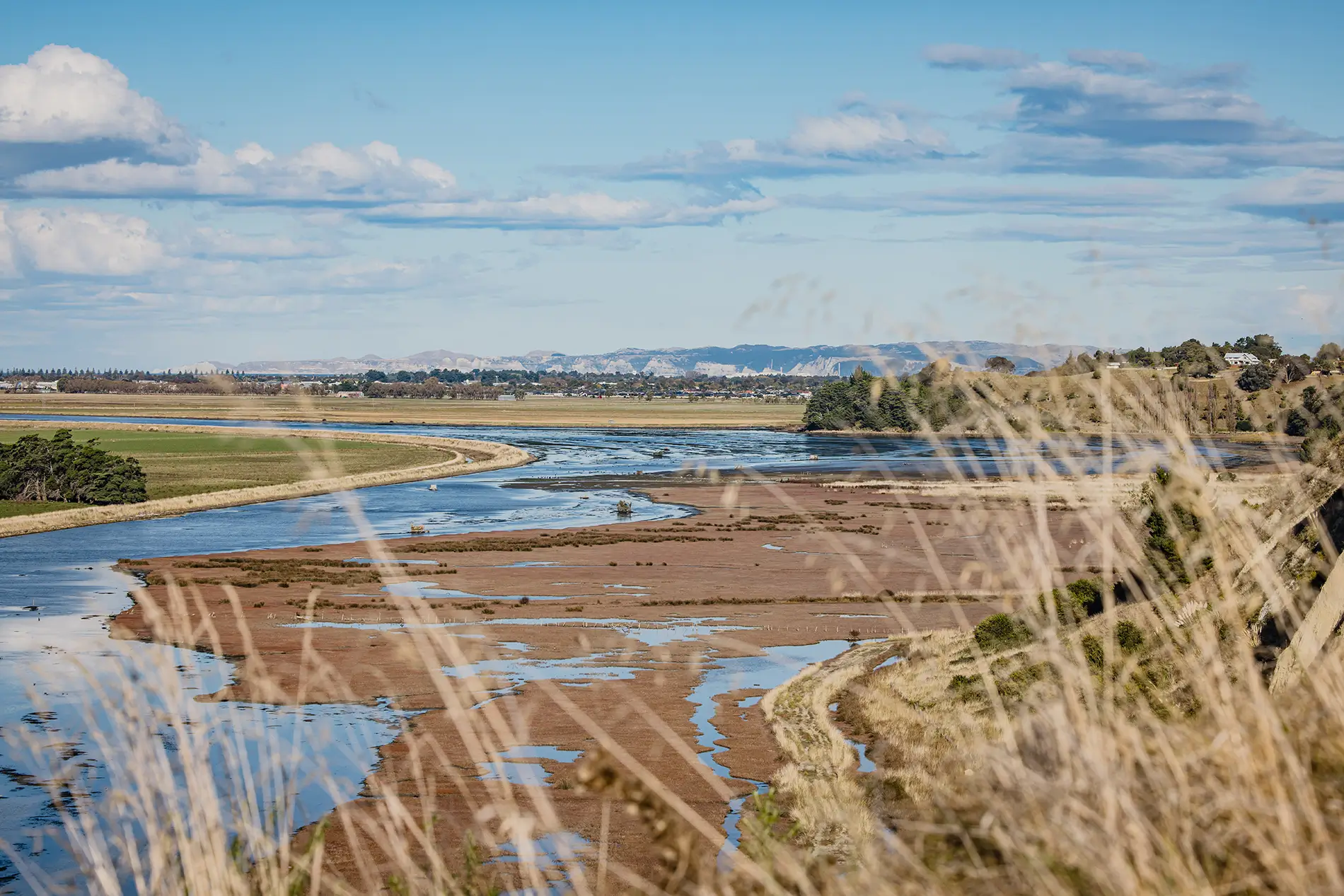
The catchment’s 70+ kms of tributaries flow into Te Whanganui a Orotū (Ahuriri Estuary),
with more than 230 landowners living within five metres of a waterway.
Impact of Cyclone Gabrielle
Cyclone Gabrielle had a significant impact on both the land and the community.
Many waterways were left exposed and heavily affected by sediment.
A key challenge now is to keep soil on the land and out of waterways,
supporting both environmental recovery and long-term resilience.
Looking Ahead
Research across Hawke’s Bay rivers, including the Wharerangi Stream within our catchment, is helping inform future action. These insights will guide how we restore and protect the health of our waterways.
To read WSP’s report “Stream and river assessments for Cyclone Gabrielle Rural Recovery Wharerangi Stream Brooklands” (written for Hawke’s Bay Regional Council).
To read WSP’s report “Stream and reiver assessments for Cyclone Garbielle Rural Recovery Wharerangi Stream Puketitiri Road” (written for Hawke’s Bay Regional Council)
Support for Landowners
We support landowners, including farmers, horticulturalists, mana whenua, small block owners and rural businesses – to improve land management across the catchment, with a focus on freshwater management, biodiversity, and climate resilience.
We do this by sharing knowledge and practical information, supporting water monitoring and hosting planting events and field days that build community involvement and demonstrate good practice.
We also connect landowners with relevant agencies and funding opportunities to support sustainable
land management.
Mini Freshwater
Management Plans
Freshwater farm plans are required for properties of 20 hectares or more, and for horticultural properties of five hectares or more. Smaller landholdings are
not covered by this legislation.
However, land use and runoff from these properties still have a direct impact on the health of the Ahuriri catchment and Te Whanganui a Orotū.
Our focus is to work with the 1,084 small block landowners in the catchment who fall outside these requirements, supporting them to improve land management and protect freshwater quality.
Mini Freshwater Management Plans for Lifestyle Blocks
We recognise a gap in practical advice and support for lifestyle block owners to improve land management, and we aim to help fill that gap.
We have developed a freshwater management
plan template specifically for lifestyle blocks and
can support landowners to get started on a plan
for their property.
The template helps identify management
options based on factors such as soil type and
slope, supporting better outcomes for land health
and water quality.
You can download the freshwater management plan template and guide here: click here.
Our Catchment Coordinator, Peter McIntosh,
supports the implementation of these plans by providing one-on-one guidance, ongoing advice,
and monitoring: Email Peter.
Mini Freshwater Management Plans
The requirement for landowners to develop freshwater farm plans applies to properties 20 hectares or greater, or in the case of horticultural properties five hectares or greater. Small land holdings are not covered by the legislation, but land management activities and run off from these smaller properties do have a direct impact on the health of the Ahuriri catchment area and Estuary. Our mission is to work with the 1084 small block landowners in our catchment area that fall outside the legislation.
Mini freshwater plans for lifestyle blocks
We see a gap in practical advice and knowledge sharing for lifestyle block owners to improve land management activities, and our goal is to fill this gap.
We have developed a template freshwater management plan for lifestyle blocks, and can help owners get started on developing a plan for their land.
This template is designed to help inform landowners of the management options for their land (based on a range of attributes such as soil types and slope) to achieve the best outcomes for improving the health of the land and waterways.
To download a freshwater management plan template and guide click here: <link: to downloadable PDF>.
Matt Truebridge, our catchment co-ordinator is dedicated to the implementation of these plans. He will provide one-on-one support for implementation, continuous advice, monitoring and evaluation.
Email Matt: <link: pre populated email to Matthew>.
ATCGT Freshwater Management Plan
We have developed a template freshwater management plan for lifestyle blocks, and can help owners get started on developing the plan for their land.
Matt Truebridge, our catchment co-ordinator is dedicated to the implementation of these plans. He will provide one-on-one support for implementation, continuous advice, monitoring and evaluation <link: pre populated email to Matthew>.
Funding for native trees
Through our relationship with Marie Taylor of Plant Hawke’s Bay and separate funding access to MPI funding, we hope to provide a quantity of native trees to each lifestyle block owner as an incentive to implement our fresh water management plan. We hope this will not only get more landowners engaged, but also will result in increased planting activities for sustainable land and water management.
Ahuriri Catchment Map Series
This useful resource of Catchment GIS Data courtesy of Sustainable HB.